The man-woman relationship
In the light of the experiences of the past year and a half I had occassion to think about the topic and perhaps was functionally oriented towards the topic as such.
I have heard that men are from Mars and women are from Venus. I have also heard that Hitler was afraid of cats but not dogs.
First time I heard that men are like dogs and women are like cats. It means according to the psychoanalyst on TV that men are simple and women are complex and hence the analogy.
Men are by and large promiscous, but he can be committed. According to him this is possible by food and appealing to his narcissism.
It is said that men talk facts and figures. For men talking is a process or media for reeling off but for a woman talking is a way of relating. This seems to be at the base of many man - woman relationship troubles. Communicating is essential for both but they do communicate different things. For the woman, the process is its own thing.
Nevertheless how can the man be mostly right when coming to the relationship with his one. First by showing that you are thinking of her, that she is uppermost in his mind and therefore some indication that he is doing so by say a phone call or a surprise etc. Second a woman needs a commitment so no roaming eyes looking for pretty ones. Third, by listening. Listen even if she is bullying your own parents. After all she is just talking. Fourth by a kind of psychosocial support. If she is getting attention from elsewhere make her know that no one can come between us.
Together when it comes to sex, keep body healthy and clean, and create novelty by creating mystery. The French seems to be better at that, it seems, according to the TV show. More on Man woman relation later.
Friday, February 15, 2008

Wednesday, February 13, 2008
Resume

SHELLY JOSE.
XI/847 U, Eastern Villas,
KAKKANAD. KOCHI.KERALA, INDIA
682 030
Contact: 98460 12176
shellyjose@rediffmail.com
OBJECTIVE
To offer a unique blend of Human Resource Management and Teaching expertise to an organization that recognizes the same.
SKILL SET
HR Executive skills (6 years)
As a junior executive, assisted the HR Head in policy formulation
Has worked as a junior level HR executive and handled recruitment, performance appraisal, and training and focused training towards ISO certification.
Teaching and training skills (6 years)
Developed course modules and taught the following subjects to MBA and MHRM students:
o Principles of Management
o Organisational Behaviour
o Reward Management
o Industrial Relations
o Business Ethics
o Environmental Management
o Strategic Human Resource Management.
o Training and Development
Industry interaction skills
Co-ordinated field work programme for students, involving building and maintaining liaison with the industries around.
Environmental Management skills
o Was passionately involved in Environmental Management Activities of Indian Oil Corporation at Barauni refinery
o Familiar with ISO 14001 provisions leading to certification including audit skills
o Teaching Environmental Management to MBA students for the last three years
RELEVANT JOB HIGHLIGHTS
as Personnel professional at Indian Oil Corporation (other than routine HR jobs)
Training, Auditing and documentation for ISO certification:
Single handedly undertook training and documentation of ISO documentation pertaining to HR.
Conducted internal ISO audits of departments other than HR.
LPG/ BPR study (Action Research) :
The LPG bottling system at the Refinery was far from optimal and required a thorough revamp. A BPR study was conducted and the following changes were recommended and implemented.
Redeployment of one personnel at the carousal machine.
Introduction of a beep sound at the weighing machine to alert the manual operator.
The introduction of a loop line to divert the purged gas from excess weight cylinders to the line instead of to the flare stack.
Synchronisation of the time between refinery, marketing and excise offices to minimize waiting time.
TRAINING PROFILE
Trained along with Engineers in Refinery operations.
Trained in ISO System (9000 and 14001, Quality and environment) study, Internal audit and Training at Indian Oil Corporation.
Got Trained and represented HR in Worldwide benchmarking exercise of Refinery by Solomon Associates, Singapore.
Current trends in teaching OB – 12 day programme at Management Development Institute, Gurgaon April 2000.
FDP participant 2001-2002 at Indian Institute of Management, Ahmedabad
Strategic Management Teacher’s Foundation Course at Indian Institute of Management, Bangalore Dec, 2007
PAPERS PRESENTED / ARTICLES PUBLISHED
“The Many ways of HR Role erosion”: article published in JIMS 8M Jan 1999
“Quantum Innovations in HR practices”: paper presented at Bangalore HR summit. Nov. 2003
“Developing cross cultural sensitivity”: paper presented at Bangalore HR summit. Dec 2004
“Towards new metaphors for a globalizing India: An agenda for Management” article published in Rajagiri Management Journal, January- June 2005
“HRM – an ethical perspective”, article published in Kerala Personnel, Annual issue 2005
Presented a paper Best Practices: Recreating the HR function at CII Best Practices Experience sharing conference conducted at Kochi on 14th October 2005.
“Industry mindset and Organisational culture” An attempt at a functional distincion, article published in Kerala Personnel, Annual issue 2007
EDUCATION
BA (English Language & Literature)
LOYOLA COLLEGE (AUTONOMOUS), Madras.
1985-1988
MA (Personnel Management & Industrial Relations)
M. G. University, Kottayam, Kerala.
1988-1990
UGC Lectureship
UGC
1997
FDP (Faculty Development Programme)
Indian Institute of Management, Ahmedabad
2001-2002
Certified Recruitment Analyst
Carlton Advanced Management Institute, USA
2008
EXPERIENCE
Sr. Personnel Officer
Indian Oil Corporation
1993-1999
6 years
Lecturer
Rajagiri School of Management, Cochin
1999 onwards
over eight years
Tuesday, January 29, 2008
Why lone wolf ?
What we see out there is not what is in there!
What may be the reason for the title of this blog being lone wolf? Am I a loner? No. Am I lonely? Yes! Am I worried about it? No!!!
This is really getting no where. But the point is being alone and being lonely are two different things. The former is the physical fact of being alone. The latter is the mental awareness and the reactions to that awareness. I am sure it depends upon a lot of other things too. For instance if ou have a job or something worthwhile doing then one tends to be less bothered about the fact of aloneness. The needs in general are for Achievement, Affiliation and Power (Mc Clelland). Or Existence, Relatedness and growth (Alderfer).
While it may be so, there may be a tendency for idealism in me too. Which makes it extremely difficult for me to have freinds too many. I am friendly in the sense of not much of open conflict with others. But to be in the company of others for far too long is a burden on me. I need some time for myself. Rather I need a long time for myself.
This is sort of achieved by limiting the affiliation only to the work place. In this way the workplace serves the purpose of affiliation and the rest of it is mostly pent alone in the company of books or such media.
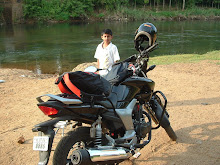
I enjoy riding, especially with my son. We hope to cover more areas as he grows older. I hope to journey through different subjects and my particular fond areas are the border between two or three disciplines. Hence a book like The Act of Creation and the ghost in the machine among my favourites.
Surprisingly the outdoors appeal to me as also the indoors. Only the journey is different. In this sense I may be bipolar. This I hope makes life a lot more meaningful. So even though I may be at ease with the people I see daily, I am also eager to get back to myself sooner than later. Hence the title
But there is one place where I am at ease. With her. And even when she is not around she is with me.
What may be the reason for the title of this blog being lone wolf? Am I a loner? No. Am I lonely? Yes! Am I worried about it? No!!!
This is really getting no where. But the point is being alone and being lonely are two different things. The former is the physical fact of being alone. The latter is the mental awareness and the reactions to that awareness. I am sure it depends upon a lot of other things too. For instance if ou have a job or something worthwhile doing then one tends to be less bothered about the fact of aloneness. The needs in general are for Achievement, Affiliation and Power (Mc Clelland). Or Existence, Relatedness and growth (Alderfer).
While it may be so, there may be a tendency for idealism in me too. Which makes it extremely difficult for me to have freinds too many. I am friendly in the sense of not much of open conflict with others. But to be in the company of others for far too long is a burden on me. I need some time for myself. Rather I need a long time for myself.
This is sort of achieved by limiting the affiliation only to the work place. In this way the workplace serves the purpose of affiliation and the rest of it is mostly pent alone in the company of books or such media.
I enjoy riding, especially with my son. We hope to cover more areas as he grows older. I hope to journey through different subjects and my particular fond areas are the border between two or three disciplines. Hence a book like The Act of Creation and the ghost in the machine among my favourites.
Surprisingly the outdoors appeal to me as also the indoors. Only the journey is different. In this sense I may be bipolar. This I hope makes life a lot more meaningful. So even though I may be at ease with the people I see daily, I am also eager to get back to myself sooner than later. Hence the title
But there is one place where I am at ease. With her. And even when she is not around she is with me.
Thursday, January 24, 2008
Life at Indian Oil Corporation
Corporate life and the mental life
I have mentioned that I am slightly allergic to the corporate life. I will try to explain. The money is good in the corporate world, but you feel confined to something. Especially since the mind has no boundaries anything that is binding to the present and intensely so is difficult for me. Being controlled and also having to control others are both uncomfortable for me.
Having to achieve is not difficult for me as long as the targets are for me and set by me. The nearest thing that comes to these is academics, even own business would mean give in to the needs of the customers or be left in the race. For all these reasons I find the corporate life unsuitable for me.
It is not indeed that I dont like or have not taken anything from the corporate world. The objective drivenness of the corporate world is somehting that I like. The disciplined ways are also so.
What I hate is perhaps the state of being confined mentally which drains me. Instread, I like to let my mind loose like a butterfly simetimes savouring, sometimes exploring, sometimes wondering and always moving to the next idea and to the next hypothesis and the confirmation or the rejection and so and so forth and the little surprises of a fresh idea or a recombinaiton of a few older ideas that makes a brainy day.
Public sector
The public sector is a vestigial remnant of the early days since independence when India embraced socialism. The period of our post graduation was the beginning of the decline of the fancy with such remnants with the new economic policy of Liberalisation, Privatisation and Globalisation (LPG for short) of Manmohan Singh who is presently the Prime Minister.
The new scenario was the dream of many like Nani Palkhivala who I remember in a TV interview actually wept at the reality of India chained up in the erstwhile policy of protectionism. I have always wondered what if India embraced a more globalised free enterprise at independence itself. Would it be a superpower? Would there be no poverty and jobs aplenty for everyone? Would the social fabric be different from the present? It is difficult to say. But I have the feeling that I would have been more of a local entrpreneur rather than an employee since the culture of entrepreneurship would have permeated our society. I believe there is a critical minimum for such kind of free enterprise to be widely prevalent. Also the social fabric would have been much more individualistic.
I have mentioned that I am slightly allergic to the corporate life. I will try to explain. The money is good in the corporate world, but you feel confined to something. Especially since the mind has no boundaries anything that is binding to the present and intensely so is difficult for me. Being controlled and also having to control others are both uncomfortable for me.
Having to achieve is not difficult for me as long as the targets are for me and set by me. The nearest thing that comes to these is academics, even own business would mean give in to the needs of the customers or be left in the race. For all these reasons I find the corporate life unsuitable for me.
It is not indeed that I dont like or have not taken anything from the corporate world. The objective drivenness of the corporate world is somehting that I like. The disciplined ways are also so.
What I hate is perhaps the state of being confined mentally which drains me. Instread, I like to let my mind loose like a butterfly simetimes savouring, sometimes exploring, sometimes wondering and always moving to the next idea and to the next hypothesis and the confirmation or the rejection and so and so forth and the little surprises of a fresh idea or a recombinaiton of a few older ideas that makes a brainy day.
Public sector
The public sector is a vestigial remnant of the early days since independence when India embraced socialism. The period of our post graduation was the beginning of the decline of the fancy with such remnants with the new economic policy of Liberalisation, Privatisation and Globalisation (LPG for short) of Manmohan Singh who is presently the Prime Minister.
The new scenario was the dream of many like Nani Palkhivala who I remember in a TV interview actually wept at the reality of India chained up in the erstwhile policy of protectionism. I have always wondered what if India embraced a more globalised free enterprise at independence itself. Would it be a superpower? Would there be no poverty and jobs aplenty for everyone? Would the social fabric be different from the present? It is difficult to say. But I have the feeling that I would have been more of a local entrpreneur rather than an employee since the culture of entrepreneurship would have permeated our society. I believe there is a critical minimum for such kind of free enterprise to be widely prevalent. Also the social fabric would have been much more individualistic.
I have started about life at Indian Oil Corporation and veered off. The group of trainees to which I belonged was composed of 14 trainees . Except me everyone was from the Engineering stream. But I never bothered and did keep my eyes and ears open although no extraordinary effort was given. I was indeed happy that at the evaluaiton I had a coupleo f Engineers behind me. My idea about Engineering graduates was completely different from what I had witnessed. First they did not have any curiosity. Second they had no real sense of ethics or the polish of professional course. Perhaps I was expecting too much. I had a notion of the training to be completely transforming like the "Officer and a Gentleman" kind but none of such happened.
Instead it proceeded at the then Hindu rate of growth. Our Executive Director was Mr. A.K. Arora who later became the Director Refineries and somewhere towards the middle of the one year training he convened a meeting of all of us and asked "what is the value addition per unit time"? I got a fancy to it and developed a notoin of the measurement of training in terms of time and also the idea of value addition.
The shuttling between the refinery and the township in the refinery bus, sort of confirmed the kind of people we were to work with. Since the Refinery was commissioned in the early sixties and this being the early nineties most of them were on the verge of retirement. And except very few who were really smart never learned anything new and confessed they were mentally retired. Also the mental retirement had a direct link to the fact that they need not expect any more promotions. The link between reward, performance and behaviour was at the best of tether.
Thinking about working with the dinosaurian legends was horrifying. Besides I was just aquiring the spoken Hindi.
My Bihar days
Although I had never a hesitation in working elsewhere, neither did I have a definite intention of working somewhere. The job situation in those days was not to our choice either. Looking back, this is a bad policy for it amounts to no policy at all. However as destiny would have it I spent six of my prime years in Bihar one of the most backward states in India.
Bihar is backward in all those parameters where Kerala my homestate is forward although this need not be construed as ethnocentrism of any sort. It ranks last in education, women's literacy, child mortality, sex ratio; in general in all the quality of life indices. Kerala on the other hand does not depict the kind of abject poverty, although the prevalence of abject poverty cannot be ruled out in Kerala as news sometimes indicate.
What I mean is, the public front in the state clearly is pathetic as opposed to more visible aspects of modernity in Kerala. As I mentioned in one of my earlier blogs it is only when one is outside Kerala, one comes across how blessed we are here. This was also shared to me by a couple from Patna who were religiously inclined on return from a retreat in Kerala.
Kerala is a string of small towns, Bihar is a vastness characterised by semi rural or abject rural scenes. The vastness of Bihar is disturbing to me as the thick coconut groves of Kerala is to the Bihari. I say this because a colleague of mine actually asked me how can people live in thick coconut groves. This may be considered to be a special case of claustrophhobia or its opposite or some such but nevertheless one cannot mistake the contrast in this regard.
To the average north Indian anyone from the south is a Madrasi although Kerlala is vastly different. They come upto Madras, present day Chennai, and go back thinking they have seen the entire south India.
Once my dhobi looked at a poster of Gabriella Sabatini on my wall and asked me "saab ye kaun hei"? (sir, who is this ?) . I replied in earnest 'sabatini' almost absent mindedly and immediately he asked me 'sabitri' ? I contained my laughter since it was the name of a Hindu goddess, the only innocent exposure that he had to perhaps being the verbalised puranas. The next question perplexed me " Madrasi hei kyaa" ? ( Is she a Madrasi"?)
A similar world view was expounded by the gardener, who asked me "What is beyond the Himalayas" ? And his favourite TV show was Hanuman. Such innocence coupled with poverty is the kind of dangerous thing that India is legendary.
I have always felt that the poor man or the average man in Kerala does indeed have a kind of hope on his face that tells "if not me, at least my children would be better off". Such hope was rare to come by in the poorest of them that I came across.
Bihar is backward in all those parameters where Kerala my homestate is forward although this need not be construed as ethnocentrism of any sort. It ranks last in education, women's literacy, child mortality, sex ratio; in general in all the quality of life indices. Kerala on the other hand does not depict the kind of abject poverty, although the prevalence of abject poverty cannot be ruled out in Kerala as news sometimes indicate.
What I mean is, the public front in the state clearly is pathetic as opposed to more visible aspects of modernity in Kerala. As I mentioned in one of my earlier blogs it is only when one is outside Kerala, one comes across how blessed we are here. This was also shared to me by a couple from Patna who were religiously inclined on return from a retreat in Kerala.
Kerala is a string of small towns, Bihar is a vastness characterised by semi rural or abject rural scenes. The vastness of Bihar is disturbing to me as the thick coconut groves of Kerala is to the Bihari. I say this because a colleague of mine actually asked me how can people live in thick coconut groves. This may be considered to be a special case of claustrophhobia or its opposite or some such but nevertheless one cannot mistake the contrast in this regard.
To the average north Indian anyone from the south is a Madrasi although Kerlala is vastly different. They come upto Madras, present day Chennai, and go back thinking they have seen the entire south India.
Once my dhobi looked at a poster of Gabriella Sabatini on my wall and asked me "saab ye kaun hei"? (sir, who is this ?) . I replied in earnest 'sabatini' almost absent mindedly and immediately he asked me 'sabitri' ? I contained my laughter since it was the name of a Hindu goddess, the only innocent exposure that he had to perhaps being the verbalised puranas. The next question perplexed me " Madrasi hei kyaa" ? ( Is she a Madrasi"?)
A similar world view was expounded by the gardener, who asked me "What is beyond the Himalayas" ? And his favourite TV show was Hanuman. Such innocence coupled with poverty is the kind of dangerous thing that India is legendary.
I have always felt that the poor man or the average man in Kerala does indeed have a kind of hope on his face that tells "if not me, at least my children would be better off". Such hope was rare to come by in the poorest of them that I came across.
Monday, January 14, 2008
What life should be like
Is it possible to decide in advance that life be in a certain way and fashion it accordingly? The prevalent view on personality /self development is matching thus. The assumption of a shapeable life does indeed have the assumption of a certain context and opportunity as well at its base. Nevertheless one's inclinations are also shaped by the context one is in and thus a certain amount of determinism is built into it.
However, a completely planned life leaves no surprises and is more mechanical. In this regard the organisational life is also a force that shapes us in the mechanical way. I am often surprised at the twin paradox of the life of the less structured and the life of the highly structured. In a way I have experienced both and perhaps I may not be able to live the life of the totally unstructured.
I am rather comfortable with a fair day's hard work and relaxation at the end of it, rather than a fair 10 month's work and one month of complete vacationing. In fact not having anything to do is abominable to me. Having to much to do is equally so.
However, a completely planned life leaves no surprises and is more mechanical. In this regard the organisational life is also a force that shapes us in the mechanical way. I am often surprised at the twin paradox of the life of the less structured and the life of the highly structured. In a way I have experienced both and perhaps I may not be able to live the life of the totally unstructured.
I am rather comfortable with a fair day's hard work and relaxation at the end of it, rather than a fair 10 month's work and one month of complete vacationing. In fact not having anything to do is abominable to me. Having to much to do is equally so.
Monday, December 17, 2007
A trip to the western ghats
I had mentioned that Kerala is blessed with natural landscapes of three kinds. The coastal areas, the midlands with rolling hills merging into one another and the high ranges called the western ghats. The western ghats run all the way from the southern part of Kerala to almost near to Bombay in the north westerly direction.
Legend has it that Kerala was formed when Parasuraman an avatar of Lord Siva in Hindu mythology threw an axe and the land was formed from the seas. Indeed there are indications that many of the land that we have today may have been sea earlier times.
One such indication is that coastal areas have a sandy top soil running into kilometers inland. Another is that in these areas when sand is dug we come across a lot of shells. I am no scientist so these needs to be taken as less scientific. Nevertheless one cannot prima facie deny any more than accept these indications. Yet another of these indications is the names of certain places. Kaduthuruthy almost 30 kms inland translated means the coastal land although the sea is far away which by conjecture may mean that once this place was close to the sea.
From a cultural ecosystem perspective the fact that these topogrpahical features tucked so close together provides an ecosystem biodiversity in such a small area.
Me and Jeff went to a place called Calvary mount on the western ghats on Saturday 15th Dec 2007 and came back on 16th. The first year students of my college were having a camp over there.(More on the camp is available in a separate blogpost.) The place is serene with not so much of cold and not too much of people either. Most of the areas around are hills or forests.
Most importantly the proximity to the Idukky dam system makes the area a tourist spot as well. Climbing the calvary mount gives a view of the reservoir made by the threesome dams idukki , kulamavu amd cheruthoi, of which idukki has no outlet, cheruthomni is opened only in case of excess water and kulamavu is the only perrenial outlet. The rest of the water is sent through underground tunnels to the Moolamattom powerhouse and hte water is left into the Thodupuzha river system. The system provides the Thodupuzha river with water perennially and that too cool water from the ghats. Something so natural and available so close to one's birthplace is much too precious to be left unspoken.
Legend has it that Kerala was formed when Parasuraman an avatar of Lord Siva in Hindu mythology threw an axe and the land was formed from the seas. Indeed there are indications that many of the land that we have today may have been sea earlier times.
One such indication is that coastal areas have a sandy top soil running into kilometers inland. Another is that in these areas when sand is dug we come across a lot of shells. I am no scientist so these needs to be taken as less scientific. Nevertheless one cannot prima facie deny any more than accept these indications. Yet another of these indications is the names of certain places. Kaduthuruthy almost 30 kms inland translated means the coastal land although the sea is far away which by conjecture may mean that once this place was close to the sea.
From a cultural ecosystem perspective the fact that these topogrpahical features tucked so close together provides an ecosystem biodiversity in such a small area.
Me and Jeff went to a place called Calvary mount on the western ghats on Saturday 15th Dec 2007 and came back on 16th. The first year students of my college were having a camp over there.(More on the camp is available in a separate blogpost.) The place is serene with not so much of cold and not too much of people either. Most of the areas around are hills or forests.
Most importantly the proximity to the Idukky dam system makes the area a tourist spot as well. Climbing the calvary mount gives a view of the reservoir made by the threesome dams idukki , kulamavu amd cheruthoi, of which idukki has no outlet, cheruthomni is opened only in case of excess water and kulamavu is the only perrenial outlet. The rest of the water is sent through underground tunnels to the Moolamattom powerhouse and hte water is left into the Thodupuzha river system. The system provides the Thodupuzha river with water perennially and that too cool water from the ghats. Something so natural and available so close to one's birthplace is much too precious to be left unspoken.
Subscribe to:
Posts (Atom)