Where the mind is free........

Wednesday, May 19, 2010

Social Psychology from College street.


The streets of Calcutta are crowded. My first visit was in 1996 for a training programme arranged for some of us officers at NIIT in view of the computerisation of the Time Office in IOC Barauni. I liked the place. It teemed with history at every corner . To be in a street with say a name like J C Bose road was honoring them as well as the walker on the street. The food habits were closer to the Kerala one. They ate fish and rice. Keralites did too. The difference was that the Keralite did plentily when he had fish. The Bengali ate one piece every day. The latter practice is closer to a nutritional one.


The classes were nothing to speak about. The food they arranged was a welcome respite from the Bihari dal , sabji, roti routine. In the evening we went about on the METRO rail. Good to see such well organized system in INDIA. The stations were named Rabindra Sadan, ESPLANADE etc. Each station had frescoes suiting the names too. It was a piece of art in tubular form running underground.


There was this street called college street. College street sold old books in neat little hutments miles on. In my next visit sometime in 1998, just out of curiosity I asked a little boy whether I can get Krech and Cruchfield . He said 300 Rs. I did not expect such a quick reply. I mean the pricing was immediate before even I could ascertain whether the little lad of 13 or 14 really did understand the identity of the book. I said show me the book and I will say. He said no. If I assure I will buy the book for Rs 300 then he would bring it from the shop a few metres away! I got shocked. Not only this lad knew the book on Social Psychology but he sure knew the exact shop where it would be readily available.


I surrendered at such pragmatism and produced the 300 Rs. He ran and came back in about 5 minutes with the exact book which was out of print since 1959. My next visit included one of the tests for VSNL when I met Indrani Chaliha from Assam. To imagine that there were young women venturing into the world from such places considered backward was sort of cute. Yet another of my visits was to Haldia Refinery as part of the benchmarking study conducted by the Solomon associates of Singapore. Once again I was in Cal with J W Kujur , my colleague of the Oraon tribe to collect gold coins for the long service award. And my last visit was in 2008 when I attended the Strategic Management Teacher’s Course Mergers , Acquisitions, restructuring and Alliances at the Indian Institute of Management, Calcutta, in April 2008. Prof. Sougata Roy whom I had met 6 years before in IIM Ahmedabad recognized me as the one who presented the HLL case 6 years back. Recognition good enough for a lone wolf who does not care to be recognized or not!


Calcutta has sort of deteriorated especially in its older parts. The infrastructure to the airport etc seems to be the places that are developing. I visited the Victoria memorial, one of the remnants of the British Raj and a 100 year old BAR which prides in exactly that and even the waites were lethargic and resigned. The autorikshaw wallah whom we tried to hire said why there are buses to that place why hire autos? The leftist state provides employment security until the employee is bored to indifference of the customer. Krech and Cruchfield speaks about the functional selectivity of perception. I am inclined to observe certain things because of some of my predispositions as an HR professional. I may have omitted to observe many other things had I been someone else. But I cannot be someone else. That redundancy is built into the very act of writing. Such is social construction of reality which Krech and Cruchfield barely mentioned and later developed by the likes of Carl Weick of the University of Michigan.

The death and sideshows


One of the sure inevitables in this world is death. It is at times of these events that man is reminded of his littleness. All the rituals especially in the Christian Syrian Catholic one is designed in a way as to remind the living the inconspicuousness and momentary nature of human lives. It no longer matters to the dead but to the living it is a reminder and even a lesson.

My maternal grandmother expired on 8/05/2010 after nearly two months in the hospital. She had a cardiac problem aggravated by pneumonia on a body weakened by medicines and antibiotics. She died a meaningful life. She had 5 children AND 11 grandchildren and 3 great grand children all including me looked after well by her through their first days on this planet. Besides, she suffered the untimely death of her third daughter who left two children one three and another barely born. We cousins all chipped in with the little bit to look after the dying child whose birth left the mother our aunty dead.

She was contributive as the de facto head of the family as the grandfather was less of a leader. She was helpful to many around as a sort of a local doctor in those days who was sought after when someone was ill nearby. She even developed a small herbal garden in the fag end of her life. She had a kind word for everyone and hence the home was resting halt for the tobacco merchant, the recycler, the ‘karippetty’ (unrefined sweetener made of palm tree extracts) seller.

For her education she did more contribution in a direct way to many. Amidst such, the little follies are pardonable. I mean being at the juncture of the feudal order giving in to the wage agricultural and then the industrial it was a little tough on that generation to leave the old order yet embrace the new order of give and take and more and more of take in a manner profitable. Her generation saw too much too fast.

She was the eldest daughter of a semi feudal landlord who acted as a local judge in the very early part of the twentieth century. Naturally she had the remnants in her own psyche and perhaps played the compassionate side of the feudal lord. The downside came to her children. Being strictly reminiscent of such lineage the children either had to have the same command or be ready to take up other work. Unfortunately they did have neither. This left them sort of proud but incompetent. The one who may be had a good combination of the two died an early death. The next generation that is the one that includes me find it difficult to match the expectations of such pedigree of moral uprightness , compassion and effectiveness combined together especially in a world that values only the third at whatever cost on the other two.

Coming to the events down on earth, the sideshows of the living in a death situation are all the more attractive. I mean if one has a certain tendency to it. They turn out to be exhibition grounds for the folly or the semi consciousness of the living. No doubt the money aspect of the death like who spent more on the treatment of such a loved one and underwent all the other sacrifices is one of them. And depending on the commentators’ own life stage this can take a real interesting aside. I mean if one knows a little bit of the background of the commentator, then one can even say what makes him behave so.


For example one has retired and is now owning a business of one’s own. And the elder son is doing the final part of the professional education which one has not had the good fortune to have and one is generally comfortable financially then one may like to make comments on who did more and less.

On the seventh day of demise there is the custom of a ritual which is more for a psychological sense of closure for the living. There were eight candles on the grave. One of them got blown in the wind and the nun was quick to relight it. The nun’s occupation or profession gave her an exceptional proclivity to perceive the blown out candle. The nuns do most of the rituals in the belief that doing them adds to the book of recordings of merits and demerits which finally decides their going to heaven or hell. This is quite palpable in their behavior. It is nonetheless wonderful to have such a belief inculcated so deeply into them that the end result intentionally or not is that the dead are taken care of and respected.

It is true that only the nun saw / perceived the blown out candle. One might theorise that the framework was incomplete without that one candle and only the one trained did see the gap in the framework, which takes us to extrapolate onto others similarly trained in other professions. Does the academician see the incomplete framework of the theory? Does the teacher see the incomplete formation of the student? Does the nurse see the missing life support? Does the philosopher see the incomplete philosophy?

Does the student acknowledge therefore that the teacher knows better not everything but better in the sense that he sees what others have not seen? And so on with every profession. Does everyone gain the humility to acknowledge the others thus? It is the profession or the occupation that gave them a particular predilection to see some things that others have not seen. There may be others who are gifted and not necessarily trained. AND therefore everyone has some contribution to the seeing.

Would it not be enough if one does the duty and remains silent without blowing the trumpet and without making comments about others? Know and Do ones duty, be ready to chip in at others’ request or hint. Keep doing until one’s days are over. Is that not enough? I think to me these are more important. A little bit of altering the time scale would give a glimpse of our lives as little windows of time in the march of eternity. Is it not enough to have a philosophy that one leaves the place a little better than one found it. And leave the scene in silence?

Tuesday, May 11, 2010

Dr. C. K. Prahalad commemorative professional network meeting


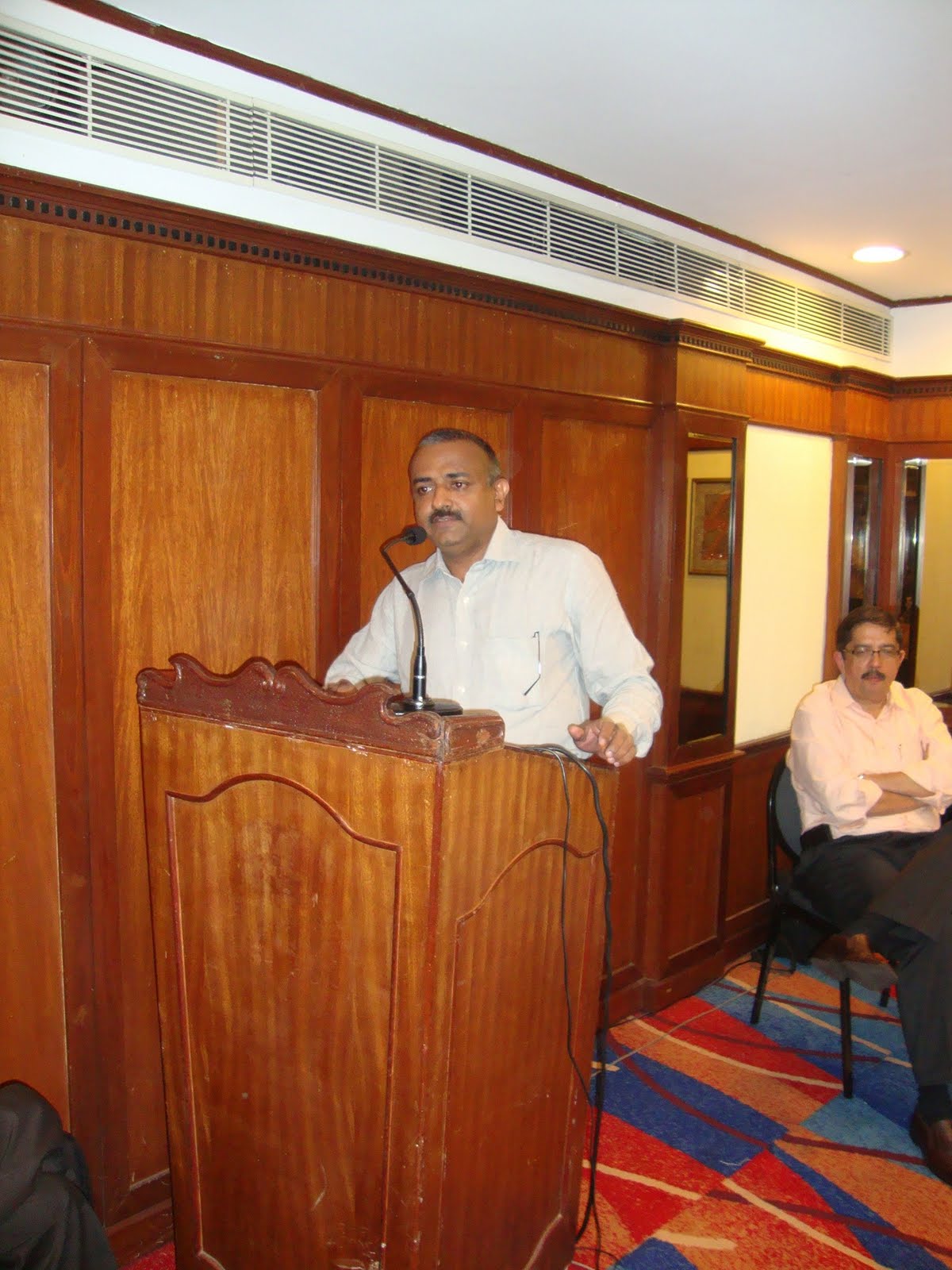
The text of the lecture I delivered at the C.K Prahalad commemorative professional network meeting at Gokulam Park, Kochi on 11/05/2010 organised by NIPM, Kochi Chapter, ISTD, Kochi Chapter, NHRD network, Cochin Chapter.


Dr. C. K. Prahalad commemorative Professional Network Meeting. 11/05/2010, Gokulam Park, Kochi.

Lecture by Shelly Jose, Rajagiri College of Social Sciences,
School of Management, Rajagiri Valley, Kakkanad, Kochi 682 039


(The other speakers were Mr. MSA Kumar of AVT Mc Cormick, Mr Ajith Kumar C S of Reliance and Mr. George Sleeba, Former CMD of FACT and presently Director of Albertian Institute of Management, Kochi.)


I shall start with one of Dr. C. K Prahalad’s famous quotes which I was fortunate to have listened to when he gave a lecture at the Ahmedabad Management Association way back in 2001. He said ‘ there is no reason why our public places should be untidy and unclean’. I am sure this does not stand out as a famous saying or something worth quoting. I shall try to explain why this was quintessentially characteristic of Dr. C. K Prahalad.

He was famously appreciative of the achievements that India had made of late. He used to often quote the example of the Communication Revolution of the late 80s and the nineties often sometimes refered to as the STD/ISD revolution.

The only resource that india had while embarking on that particular revolution was the political will and technocratic leadership. Our infrastructure was nothing to speak of then. There was also a culturally significant aspect to the revolution. Our nation is studied and classified as a highly collectivistic one. Therefore the objective of the communication revolution was simple. “ To provide telephone connectivity in every village”. Please do remember we are talking about an Indian village and not a Kerala village. Had it been a western individualistic endeavour, the objective would have been “ to provide telephone connectivity to every individual”. In a country of 100 crores of population this would have been impossible, even disastrous. That brings us back to Dr. C. K Prahalad. In this case the solution and the problem were wrapped up together. One of our problems at that time and even today to a great extent was the unemployment. By providing the STD booths, India was also generating employment opportunities to many. In effect the problem was looking for a solution when it was right there.

Another one of his famous examples was the dhabawallahs of Mumbai which most of us are today aware of and is very interesting from a management perspective. The dhabawallas have no resource except for a numbering system which they systematically follow in the chaos and din of a typical Mumbai day. The infrastructure that they depend on namely the suburban rail system in Mumbai is a common or shared infrastructure and not an exclusive one. The other infrastructure is the tiffin boxes which are actually owned by the housewives. The real resource is the simple numbering system that indicates the household, the street, the departing station, the arrival station and the final destination an office or any workplace. The system works with less than one percent inaccuracy. The whole thing is run on a peculiarly Indian custom of liking to eat fresh, hot homemade food.

Yet another of these examples which Dr. C K Prahalad was fond of but awaits development is the Indian Postal System. Reaching an individual household of a nation of 100 + crores is a nightmare. But one organisation does that every day for the last more than 100 years with 99% accuracy. That is the Indian Postal System. The potential value to be unlocked from this system surpasses the communication revolution or the dhabawalla example. If we can use the postal system or even merely the potential database that it can generate, that would surpass the world’s best mail order business.

Let us come back to Dr. C. K Prahalad again. Why are we quoting these examples. In all these cases the ambitions far outweigh the resources. To quote Dr. C. K Prahalad, “ambitions by definition are far more than the resources”. If the Mughal emperor hesitated like Hamlet about the resources there would never have been a Taj Mahal. If in the eighties we worried where the infrastructure would come from for the communication revolution there would not have been the telephone system we have today. Remember it was this infrastructure that served as the backbone of a subsequent revolution called information technology which we call today the ICT or the information and communication technology for which India is noticed by the entire world.

Many wonder whether there is anything quintessentially Indian about many of these, because many of the other success stories of yesterday were peculiarly different. The Romans had a great empire, but it was actually built by slaves. The British had an empire, but it was also the result of another equally unequal relationship of the colonizer and the subjects which all the civilised world frowns upon today. Americans had a vast and fresh continent full of resources and a relatively well developed human and technical resource from the old world to become a superpower in the twentieth century. India is the only country which has never invaded another for expansion in its entire history. What we know of and the western writers such as John Keay comment upon as the resilience of the Indians is this; that with minimal resource we can achieve remarkable feats given the right kind of will.

Let me come back to Dr. C. K Prahalad again. His argument or rather observation that ambitions are far more than the resources’ was theorized into what is called the ‘strategic intent’ in a paper he co-authored with Gary Hamel in the May- June 1989 issue of the Harvard Business Review. For perhaps the first time, the authors undermined the till then sacred notions of ‘strategic fit’ because ‘strategic intent’ flies in the face of strategic fit. An entrepreneur or a manager waiting for all the resources to fall into place would wait forever but one that sets the objectives far above the resource would achieve it. Dr.C.K. Prahalad quotes the examples of Komatsu, Honda and Canon in that paper. Komatsu in the 70s was less than 35% as large as Caterpillar in sales. By 1985 it was a 2.8 billion $ company. The story is elaborate but the intent was compressed into two words; “ Encircle caterpillar” .


Similarly Honda was smaller than any American Car company. But by 1987 it had started manufacturing as many cars worldwide as Chrysler. Another example he was fond of quoting was that of Canon and Xerox. Conon was a small company manufacturing lenses. Xerox was a company whose name was synonymous with photocopying. Canon by the late 80s had matched Xerox’s global market with a mean and short internal catch line, “ Beat Xerox”.

To quote C. K Prahalad again “ The lesson is clear; assessing the current tactical advantages of known competitors will not help you understand the resolution, stamina and inventiveness of potential competitors”. This ambition out of proportion to their resources and capabilities was at the centre of C.K Prahalad’s thinking. He was emphasizing that jumping a ditch of 8 feet would not be possible with two separate jumps of 4 feet each.

That makes us think what made C. K Prahalad different from the other management and strategy thinkers. Let us try to consider C. K Prahald with Michael Porter and Peter Drucker. Michael Porter is considered by many as the father of strategy thinking in business. His ideas chiefly were summarized under the five forces approach to competitive analysis or what now we understand as the structural analysis of industries. These five forces are rivalry among existing firms, the likelihood of Potential entrants, Bargaining Power of suppliers, Bargaining power of buyers and the threat of substitute products or services.

The framework of the core concepts of competitive strategy of Michael Porter include the cost leadership, Differentiation , Cost focus and differentiation focus. When we analyse both the five forces approach and the core concepts of Porter they derive from what we understand as the opportunity and threat side of the SWOT framework.

Let us now look at Peter Drucker’s strategy thinking. Among his many writings on Management thinking, the most strategically oriented is a paper titled “ The theory of the business” HBR, Sept- Oct, 1994. His main concern was that the right things are done but fruitlessly. The solution that Drucker advocated was to constantly examine the mission of the Corporation against the actual reality, the corporation’s assumptions about the environment and the core competencies of the corporation. Drucker emphasized that these three . ie the assumptions about the companies’ mission, environment and the core competencies must fit reality.

Let us come back to Dr. C. K Prahalad and his idea of strategic intent once again. If Canon or Komatsu or Honda tried to match the external realities as Drucker theorized they would never have beaten Xerox, Caterpillar or the American Car companies. Instead they reformulated the companies’ mission beyond their current capabilities and then developed the competencies for the same in leaps and bounds.
If Canon, Komatsu or Honda merely did a five forces analysis of their respective industries as Porter would advocate, the entry barriers were so great, they would never have beaten Xerox, Caterpillar or GM. The idea of strategic intent that ‘ambitions far outweigh’ the resources or even the reality, offers more than Michael Porter or Peter Drucker in superior and sustainable achievement as these examples suggest.

That brings us to the question of how was the idea of Prahalad different from that of the major stalwarts of strategic thinking.
Two of the other major theories of Prahalad might answer the question. The theories of both Porter and Drucker were heavily focused on the competition whether it is the five forces model or the assumptions about the environment. On the other hand Dr. C. K Prahalad focused on the inner strength of the firm and hence the idea of the core competence. While Porter and Drucker were focused on the external world, Dr. C. K Prahalad examined the inner strength of the firm and found from the examples of Canon, Komatsu and Honda that they created a mismatch or a misfit with the external environment. In this they had no idea except that they had to overcome certain forces. How to overcome was secondary. That they have to overcome the forces was primary.

How did these companies do it? They knew that the existing theories of strategic thinking merely repeated the game of ‘catching up’. So the prevalent ideas were that of benchmarking, TQM and reengineering at the operational level. But these techniques have a problem. They are merely techniques that can easily be imitated or even bettered. It is only a question of time, a question of ‘when’ rather than ‘whether’. So eventually after one firm catches up and may be overcomes, the other firm also catches up with the first one and surpasses. This will only lead to a game of endless catching up.


Dr. C. K Prahalad and Gary Hamel’s answer was to look within and develop what was termed the ‘core competence’ in a paper from HBR May- June 1990. Core competence was a going back on decentralization or rather a reflection on the family values of a decentralized entity. Consider Canon. The product line is many from cameras to medical imaging to photocopiers. But at the core of all these products is the lens, the manufacturing of which Canon will never outsource. Consider HONDA , the petrol engine which is at the core of all HONDA products they will never outsource. In fact, the founder of HONDA Soichiro HONDA was an automobile enthusiast and a racer who tinkered with the petrol engine and fine tune it everytime he lost a race. It is the founder’s enthusiasm that is captured in the Honda engine that further is the hallmark of all Honda products.


The game of ‘catching up’ that the other strategic thinkers inadvertently advocated ended when the firm hit the core competence of the rival. They found that the core competence was valuable, rare imperfectly imitable and non replicable (VRIN). Today the idea of core competence and strategic intent has developed into a new branch of strategy called Resource based view (RBV). RBV concentrates on enhancing the strengths and mitigating weaknesses more than on opportunities and threats and in the process strengthens themselves so that others find it difficult to emulate. The competitor to Honda can replicate many things but he can never replicate the enthusiasm of the entrepreneur Honda. A company can hire the employees of another company, but they will never be able to hire its organizational climate or culture. These aspects namely the history, culture and the legacy are the things that eminently qualify for the adjectives VRIN.

HR professionals may have noted that all these variables such as culture and legacy are in fact outcomes of HR whether we use the term HR in the sense of resource or in the sense of practices.HR practices are what leads to the unique culture and unique culture is what is the unique competence of the firm.

Coming back again to Dr. C. K Prahalad in promulgating the idea of core competence, he was pinpointing the central precept of strategy. In emphasizing the strategic intent he was advocating and exhorting an attitude that was the essence of entrepreneurship. The history of the latest revolutions such as the computer revolution is replete with examples of an ecosystem of firms that co create and reinforce each other. The idea of co-opetition was one of those ideas by James F. Moore of the famous moore’s Law that he came out with in a paper titled ‘Predators and Prey’: A new ecology of competition’ in HBR May – June 1991. Dr. C. K Prahalad extended it to the problems of India. He creatively extended the idea to co- creation and applied it o the problems of India and brought together business interests and poverty alleviation which was formerly thought to be incompatible. The result was the idea of ‘Fortune at the bottom of the pyramid: Eradicating poverty through profits’. In a way the solutions to the problems lay in the problems themselves and this was the insight that Dr. C. K. Prahalad unearthed for the benefit of both business and society. The results of this idea is now found in products as wide ranging as from shampoo sachets to the Nano car.
I would conclude that Dr. C. K Prahalad is the example of the quintessential Indian synthetic or synthesizing thinking in which everything even diverse things and ideas had a place in the universe as against the analytic and prescriptive thinking of the western mind. In putting forth these ideas whether strategic intent, core competence or bottom of the pyramid he was actually putting forth the integrative, resilient and compassionate Indian mind into the business world.
----------------------.

Tuesday, April 13, 2010

Heedful interrelation


I had a flash of insight one day when I was at the exam hall invigilating. The idea is pretty simple and is requisite in all human interactions but the theorising requires some technicalities. And in reality all hierarchies are a requirement arising out of information imperfection which is as such in reality in this world at least.

Unfortunately information imperfection is misconstrued as opportunities to grab power and hold on. Here is the article which will soon be published....


Heedful interrelation as the key to system efficiency and hierarchy as a compensation for information imperfection:- Illustration from administrative situations

by SHELLY JOSE

ABSTRACT

Literature is replete with team building necessary for the efficiency of the system within the dominant paradigm of individualism and competition. A new strain of positive organizational behaviour literature hints more at interrelatedness rather than competition suggested by individualism. The present attempt is to posit greater system efficiency that can be generated within a networked behavioural environment drawing illustration of a simple system such as exam administration and further extrapolation to more complex systems such as a traffic junction administration. Further extrapolation may be possible in more complex systems however, with necessary information dissemination and minimal hierarchy enough to offset the transition from the simple to the complex. Moreover it might even be possible to posit that hierarchy itself is a necessity born out of inadequate information dissemination and heterogeneity of activities.

Shelly Jose teaches at Rajagiri School of Management, Kochi and has both management teaching and industrial experience. His current interests include Oragnisational Behaviour and Strategic Management.


Introduction.

Any system would have system efficiency as its objective. Can behavior of actors in a system be contributive of system efficiency or inefficiency? If so, what would constitute appropriate behavior? That would require an examination of the system. It would also require that the dominant paradigm be modified and represented appropriately that the individual actors know their role towards greater system efficiency. Positive organizational behavior offers some insights to develop such a system efficiency based on actors’ behavior. An example is drawn from a simple system such as exam administration to illustrate the concept of positive organisational behavior with emphasis on directiveness.

The concept of Heedful interrelating, mindful organizing and respectful interaction

The concept of heedful interrelating forms a trio with respectful interaction and mindful organizing in appreciative inquiry strain of organizational behavior. It can be summed up in the words of Weick as generally mapped out sequences, of highly trained people capable of improvisation and adaptation. The key here is joint capability to function as a single mind. Further, a major property of heedful interrelating is that the people see their work as a contribution to a system, not as a standalone activity. People act as if they are under the direction of a single organizing centre even though no such centre exists.


When people act as if there is something towards which they contribute, ‘that something’ starts to materialize, a key component of a self organizing system.

Another property is the representation which is a shared visualization of the meshed contributions. Each participant has a representation that includes the action/s of others and their relations. And finally, people treat their system as their referent and act in ways that meet the needs of the system.

The concept of mindful organizing in positive organizing would mean an organising that enriches experience and pragmatically improves perception, alertness and adaptation through efforts to refine and differentiate existing categories, create new categories and detect subtle ways in which contexts vary and call for contingent responding. And respectful interaction would entail trusting, being trustworthy and maintaining self respect.

Sense making resources.

Interaction and conversation (social), clear frames of reference (identity), relevant past experience (retrospect), neglected details in the current environment (cues), updating the impressions that have changed (ongoing), plausible stories of what could be happening (plausibility), and actions that clarify thinking (enactment) together form the sense making resources.

The simple system of exam administration and the constraints
The exam administration in the traditional system has two broad functions; one of supervising the students and the other of providing the requisite stationery for the students. The provision of stationery i.e. answer booklets for writing is in the normal course simplistic however, with stipulations on restricting the supply only upon requests, poses a constraint, needing invigilators to be alert to the requests and to be acting in ways as to minimize loss of time. Time therefore is also a constraint built into the system.

The number of administrators is also restricted due to the constraint on enough people to spare. The job is essentially of a non productive nature or productive only in a deterrent sense. Because of the requirement of silence in the exam hall, information of a request is generated, understood and passed on through gestures at best.

Fig 1- Exam hall


The paradigm of competition would in this case mean more number of stationery distributed by a single administrator. However, more importantly, system efficiency would mean less movement of administrators or less time from request to supply.

The actors in the system are the invigilators and the students undergoing the exam. Interaction could be between the invigilators or between invigilators and students, but not between students.

Heedfulness, mindfulness and respectfulness in the exam administration system.


Now let us apply the heedfulness, mindfulness and respectfulness discussed in the first part to the exam administration system. For illustrative purposes, a typical examination hall would be a hall with students in 9 columns with 20 rows. An approximate number of examinees would be 120 to 180. The number of exam administrators is 3. (See fig 1)

Heedfulness of the administrator would mean alertness to the requests and an approximate gauging of distance of the administrator(s) from the request spot and delivery either himself or alerting other administrator/s. A competition or game theory paradigm would require an administrator to be eager to deliver the stationery himself whereas the system efficiency paradigm would require one to gauge that another administrator may be near the request and alert him in turn to deliver. It is the system efficiency paradigm that is sought to be examined and mapped here in this article.

Efficiency can be added if there can be a mental map (representation) of the exam hall being divided into as many sectors as there are number of administrators. Further it is expected that the administrators keep moving both for the purpose of watchfulness and for the simple fact that mere standing in one place is ergonomically undesirable. The requests for stationery can then easily be responded to, depending on the position of the nearest administrator.

Further the mental map can be used in such a way that the administrator moves as if the area is divided roughly into the number of administrators and adjust self movement to fill the vacant area created by a moving administrator so that at any moment no request is too far away from the particular student examinee.

Therefore the appropriate self movement would then be such that the longest distance would be the longest distance within the divided area. At some moment a rest pause is a possibility for one of the administrators in which case the total area is mentally mapped by the rest of the administrators to be divided into A/ ( n-r) where A is the total area, n is the number of administrators, r is the number of administrators taking rest pause.

Efficiency would then mean least distance of the administrator and the avoidance of wasteful movement of a particular administrator as to move any distance more than the longest distance within the A/n area or A/ ( n-r) as the case may be. The heedfulness, mindfulness and respectfulness in this case would mean that the system efficiency paradigm would require a distant administrator to gauge that another administrator may be near the request and alert him in turn to deliver.

Adding heedfulness of requestors

Since the administrators are on the move it would be possible to have further system efficiency if we add heedfulness of the requestors as well. An individual student requestor can very well anticipate his /her stationery need and request as the administrator approaches, eliminating the need for a distant request. This would further reduce the request – approach – delivery time delay.

The new improved sequence that gets enacted would then be

Approach-------------- Request ----------- Delivery
replacing the former
Request --------------- Approach ---------- Delivery

with least time lag in the sequence.

The system in a small area would need more of a networked interaction between the administrators with non verbal interactions than a hierarchical one unlike as with a music conductor and the musicians.

A hierarchy would be needed only if all administrators can’t perceive each other and their relative positions. The hierarchy is then less useful. The networked interaction (in contrast to the hierarchical one) would nevertheless leave room for directiveness when a particular administrator may be alerted by another one as to a request near to the one alerted in an event he has not noticed the request.

In a way, the absence of hierarchy and the emergence of the need for alerting would generate directiveness alternatively from each of the administrators (mindful organizing) and we could say for the moment the apex of the hierarchy shifts to that particular alerting administrator after which the network goes back to its original non- hierarchical state.

Higher levels of complexity and heedfulness.
We can now move on to heedfulness on situations involving multiple actors and greater complexity as in a traffic system.

Fig 2 - Traffic junction

Since at any given moment, the individual driver’s information about the terrain is only limited to his visual field, a hierarchy becomes necessary at the traffic junction manned by police personnel with authority. If information was perfectly available to all the drivers and they were all capable of heedfully interacting, the need for hierarchy (directiveness from the police personnel) is reduced so much. Even with such a hierarchy, the actors’ heedfulness would reduce the load on the police, provided all the actors transmit their intentions (using proper signals) unambiguously and cooperate accordingly.

We can add levels of complexity further such as a railway signaling system and an air traffic control system etc. and in all such situations it is found that behavioural adjustments in terms of heedful interrelating, mindful organizing and respectful interactions between the actors facilitated by the hierarchy forms the basis of system efficiency. However, the key point is that hierarchy in this sense is a necessary addition only to compensate for the information non- availability to the actors arising out of the progressive complexity in each of these situations.


Fig 3 Railway signaling system


Fig 4 Air traffic Control system


Fig 5 The economy as a system

Can we therefore postulate that systems such as the economy at large would also benefit from the heedfulness, mindfulness and respectfulness of the citizens and mediation and directiveness from authorities such as the government only to compensate for the information non availability due to the complexity once again?

And given the qualitative behavioral changes, the role of the government or any authority would diminish as to intervene only by exception further raising the efficiency of the system as a whole. This would eliminate disruptive tendencies such as power for the sake of power and in a networked environment, power or in simplistic terms, the presence of directiveness shifts in such a way that the alerting becomes of more significance than mere power holding and actors would not hesitate to be alternately alerted and directed and also alerting and directing depending on the circumstances, adding to system efficiency overall.

Conclusion

The discussions on organizational behavior till recently considered behavior from a deficiency perspective requiring corrections or gap filling. This necessarily followed form a therapeutic approach as with many other discussions relating to post war psychology. Discussions on what works were overshadowed by what did not work and what interventions were required. The new strain of positive organisational behavior takes an opposite view and is expected to give less resistance compared to the deficiency – gap filling perspective of traditional organizational behaviour.

The foregoing discussion tried to bring in examples from simple administrative situations and extrapolated to more complex systems. Much of the necessity of hierarchy is redundant in the emerging networked world which fact is however less evident due to the predominant non- examination of the dominant prevailing wisdom of authority and directiveness. The discussion posited authority and directiveness as a necessary feature only of systems that have inadequate information dissemination and presence of complexity. Given the networked system, it may be necessary to redraw the lines so as to allow for the emergence of centres of authority and directiveness alternately diffused in the nodes of the network determined by the need for alerting other nodes. Heedful interrelation among the actors is paramount in such a model and the same is less appreciative of competitive interactions than cooperative interactions and one could say that as such, the model is focused on system efficiency and redefines competitiveness as the ability to heedfully interact.

----------------------------------------

Tuesday, March 30, 2010

CSR through sensible market intervention

The article on CSR as Consumer Social Responsibility (ET, 30th March 2010), by Nitish Kumar of XIMB did not make any sense to me. So I wrote a response to ET as below; Hope they will publish it or else.....


CSR through sensible market intervention rather than consumers

This is a response to Nitish Kumar’s article in the POLICY page on CSR as consumer social responsibility. (ET, Tuesday 30th March, 2010.)
The debate on whether it is possible for a bottom up approach from consumer awareness and choices to social responsibility postulates that the consumer’s informed freedom of choice would lead to CSR. Nothing could be farther from the truth. First of all the price sensitivity of the Indian consumer has not been considered, although it is implied in the consumer’s preferences for cheap Chinese products.

The consumer in a developed economy is different from that of a developing one. Besides, the ‘consumer’ is an amorphous term. There is not a single entity called the Indian consumer to be called as such. In a more developed economy such as that of the US, because of the presence of consumer activists such as Ralph Nader there can be concerted efforts from the consumers side , but the Indian consumer is still unorganized.
Therefore educating consumer would call for the question, which consumer? If the answer is ‘everyone’ is it possible to educate everyone where the author himself has suggested that the government has failed?
On the other hand, business houses are more concrete and numerable. However the article implies that it is unlikely that the business houses would take responsibility for pollution or CSR. That is why an alternate idea of consumer as CSR in the first place.


That the consumer would be able to determine the CSR or pollution control by his freedom of choice is counter to experience since the matter is age old and is the first text book reference to negative externalities such as pollution as examples of how the market mechanism itself fails in certain cases.


Coming back to the Indian consumer he is still not willing to pay more or demand for environmental performance or CSR in his choice of products or purchase decisions, leave alone thinking about ultimate prices they pay. The Indian consumer is worried more about how affordable something is.


Given the above, that is, consumer not ready and the corporate not expected, then the only way to mitigate the negative is by diktats and law enforcement. However, that can also be not expected as the article says the government has failed in its functions.


However, there are ways in which the government can induce the consumer to prefer and the corporate to invest in less polluting technologies. One such method is by removing subsidies, for instance, on oil, if not all on a sudden but in a phased manner. When oil prices are left to be market determined, their prices are sure to find market equilibrium at a higher level than the present one.

This would trigger efforts at alternate energy. The relative cost of the alternate energy comes down and eventually becomes less than the oil prices as volumes reduce unit costs. There will be a time when using polluting oil would be costlier than using non polluting alternatives. The only factor that makes oil attractive presently is the subsidies on oil at the cost of the taxpayer.

For the CSR or Environmental responsibility an economy hopes to achieve by consumer freedom of choice, the consumer should first be given a choice. The government should divert the subsidies on unclean technology such as on oil and its derivatives to the cleaner alternatives. By doing so, the consumers , the producers and the society at large benefits.
Merely hoping consumers would take up CSR and business would educate consumers would remain exactly what it is ; Hope!


Author details : Shelly Jose, Teaches Environmental Management and Business Ethics at Rajagiri Centre for Business Studies, Kochi.

Thursday, March 18, 2010

A paper on popularisation of Management


In 2002 while I was doing the FDP at IIM Ahmedabad, professor M.R. Dixit had given an assignment on the 'Future of Management'. The predominant schema in my mind at that time revolved around the ideas of Management, bottom of the pyramid, culture and the peculiarity of Kerala economically, socially, environmentally and demographically.

The same was reflected in the paper. Here is the paper in an article form..


Emerging organisations and popularization of Management as a discipline; the case for a Kerala model of tourism

Shelly Jose

Abstract


The following paper postulates that the forces of egalitarianism are inevitable due to the forces of technology and globalization, which will necessitate a revamp of the hierarchical business model of today. This will have behavioral and societal consequences. A grounded, community-based business model based on the peculiarities of Kerala as a geographic and social entity distinct from other regions of India is a logical extension of the same argument.


Introduction


The two dominant paradigms that distinguish our age is the explosion and ubiquity of information made possible by the leaps in information technology and the movement towards globalization. With this in mind, the following future scenario of management as a dynamic component that changes to adapt to the times (in no small measure created by Management itself with its bias towards action and development) is discussed. A context for such application and integration of ‘Management’ at an egalitarian, grass root level is illustrated in the background of Kerala’s potential as a tourism destination.


Changes in organisations due to greater need for focus

As more and more differentiation takes place due to need for focus, there will be more and more specialized organizations. Due to the forces unleashed by liberalization, Indian organizations also are likely to move towards further specialization. For instance there is likelihood of more and more organizations emerging purely for research and development. More and more R&D will be outsourced even in the social sciences. Already some like Marketing Research do exist. In the social sciences, there is likely more and more institutions doing theoretical research, much like the physical and natural sciences. The action research will take stimuli from theoretical research and work on. So the differentiation will be for example, in terms of traditional organizations, action research organizations and theoretical research organizations.

In essence, this reflects a tendency towards subcontracting of major operations as well. However, since reliability is a major issue even subcontract organizations will need to establish credentials in terms of high levels of integrity and efficiency. This requires highly specialized management practitioners and practices in the research field. The maintenance and certification of standards will be a major offshoot of this development which will be another knowledge based managerial domain. More importantly the importance of such developments indicates the movement of ‘Management’ as a discipline to more grassroots and specialist levels.

The key managerial adaptation for the subcontract organizations will be of knowledge / idea acquisition, classification, and transmission all for more and more specific kinds of industries and purposes and the building up of necessary credibility.


Changes in organisations to IT revolution

Due to the maturity of information technology and its wide dissemination, as more and more functions become amenable to be outsourced from people working from their homes, amenability being the digitization, transmission and security of documents, all through advances in the software technology, the future role of some managers will be that of managing and co-ordinating these SOHO (Small office home office) operators perhaps from their own SOHOs. Once again, SOHOs will have to establish their credentials in terms of integrity and efficiency. In this we will be creating a new breed of contract SOHOs, the commitment of whom will be of the order of buying into the values and practices espoused by the companies just as the customers are loyal to the quality of products that these companies offer. As the SOHO employee will enjoy much more autonomy and is much less in degree a member of the organization, retaining him will require a different order of talent. It is likely that organisations will not be vying for talented employees but credible autonomous SOHO employees.


As the SOHO employee is free to take on assignments from multiple sources there is a likelihood of pervasive permissiveness. The anguishes of the market economy such as lay off and retrenchment will be of a lesser nature as the SOHO employee is less likely fully out of job. This is a pleasant scenario, in a way prompting many to become SOHO entrepreneur employees. As companies come and go, disintegrate and reconfigure endlessly, the SOHO will remain as the centre around which activities arrange themselves. Society will arrange itself in a new kind of egalitarianism. A fluid ambience convenient to all the players will be the likely order. In fact this will be a new kind of situation where the freedom provided by the fluidity, the freedom to come in and go the freedom to make a mark and move on will outweigh the security provided by lifelong employment.

Managerial talent of big organisations surrounded by SOHOs would be of a kind much in the same way of developing and maintaining relationship with a back up list of vendors, suppliers and contractors.


Changes in Power distance

As more and more of these needs are taken care of by smaller and smaller organizations, the society’s notions of status as in the traditional hierarchical organizations will also acquire new meanings. When everybody interacts in an increasingly less face to face manner, society will once again shed its power distance to take an egalitarian shape.

Those individuals who are unable to comprehend the change of power distance that they ostensibly kept to keep themselves in the upper dog’s position will feel alienated. This would be a new order of alienation, an alienation of the upper dog. As a high power distance society grapple with the alienation of the upper dog more social innovations may be required to counter these.

As access to information becomes more and more pervasive in the form of more number of TVs and other mass and individualized communications, the traditional divisions are likely to wither away. As at a younger age a child born for instance in lesser circumstances watches more and more egalitarian interactions (not to forget the others conscious efforts by society at removing differences) they are likely to discard many of the attempts at the reinforcements of inequality. Same is true for the child in better circumstances whose acculturation takes place in large measure with the public media, as he will be able to see the less fortunate one child in more egalitarian terms. In a way what social change was warranted to be achieved by other means would be achieved by the almost automatic and ubiquitous information provided by the information age driven paradoxically by the profit motivated market forces.

Another reason for the emerging egalitarianism is that unlike in previous eras the increase in wealth of the well to do is accompanied by an increase in the wealth of the lower strata as well.


The Implications for organizations is that the inculcation of the egalitarian awareness will force the next generation to be more and more networked / flat and less hierarchical.


An Indian Management Service than an Indian Administrative Service

As Dr. C.K. Prahalad says, all the Indian successes have a similar pattern. They all relied on state of the art technologies, used different non- western business models and the leaders knew the businesses (read they were not bureaucrats). Examples are operation flood, green revolution and the DOT. In all these cases the solution to the problem of poverty itself was the new opportunity. What it means is the taking over of the Indian Management by the non- bureaucratic business managers. An Indian Management Service (IMS) on the lines of the IAS could supplement the IAS where specialist –generalists ( jack of all trades and master of one) could be produced on the lines of a rapid action force (but with a bias for consistent, intensive action) from among the existing and also non-traditional managerial pool. Any lack of knowledge of the business will be punished by the market economy in its natural function.


An alternative business model in the tourism sector for Kerala.

More sectors would try to duplicate the successes of the type of DOT and operation flood. One possible example is postulated below. What is likely to emerge is a Community tourism model for the state of Kerala in lines with the Anand experience. In a socially progressive, but economically backward state like Kerala, the special combination of stabilization of population at replacement level, education, almost total investment in built up domestic dwelling, information backbone and tapping possibility due to its north south orientation, above average transportation facilities and communication facilities and high literacy would help open up newer models of tourism. The high population density and the string of small town pattern, which renders distances smaller than in other states do also make the model a viable one.


The ‘National Geographic traveler’ has listed Kerala in 1999 as one of the must see destinations of a lifetime. The interesting feature is that the only other place in India featuring in the list was Taj Mahal which is only a monument compared to the whole of Kerala so many square kms of it.

By extending the logic, by simply building quality roads, Kerala can be initiated into village and ecological tourism by the community approach at considerable cheaper rates to the tourist. All that is needed further is a home stay model accommodation in existing farm houses and other houses in scenic ambience. This would bring about a grass root level revolution with grass root beneficiaries in much the same way as Anand. The fact that the potential is enhanced by the traditional cash crops like rubber plantations and the natural beauty of the state provides a natural advantage to Kerala. This brings us to a new need in the academia namely ‘Tourism management’ for households.


Tourism Management for households

The managerial talent in this instance needs to be extended to every household, which would be a great experiment in popularization of management skills perhaps for the first time in the history of the world. Among the many other firsts to Kerala this could be an additional one. The present advances in social indicators can thus be very conveniently tapped in the tourism business at a very low investment.

This would mean that guides chosen from the villages shall have to be trained in language, local customs, flora and fauna to be explained to the tourist. The other facilities of near ubiquitous transportation access to telephone are already at a higher density and quality than the rest of the states. This combination makes Kerala a unique place for such an experimentation. The model also will be easy on the need for more hotel accommodation. The western tourists are out on an escape trip from the luxuries they are so used to. There is very little justification for providing opulent luxury in five star hotels here. Rather the village/ecological/exotic household culture ambience is the product that needs to be packaged. In a flash, there is no difficulty in seeing that the solution to the problem (of unemployment, low returns from land) is itself the business opportunity.

It is relevant to mention that the subject calls for both the inputs from the domain of tourism as also from that of management especially human resource, logistics, operations, public relations and household management. A great deal of emphasis can be given to the behavioural and personality development and cross cultural sensitivity.

A first line of action could be the training of willing youth from the countryside to be host-guides to foreigners. This could also double up as a valuable addition to the Human Resource Development of the nation besides generating valuable foreign exchange.

The objective is to further strengthen the position of Kerala as a world class destination. A look at the world map indicating the prevalence of homestay concept shows that the concept is though well entrenched in the rest of the world, the most frequent reference are to Thailand and Cuba. However adequate precautions need to be taken for avoiding the pitfalls of their experiences.

As can be observed, the model is made all the more possible by the advances in information technology, the increasing globalization and the social and economic peculiarities of Kerala. Similar indigenous business models can be explored in other states suiting the local conditions. In all cases what is predicted is more egalitarianism and grass root level popularization of ‘Management’ at the rural household level as a new model of home ‘office’ for national product generation itself. This serves some of the qualifying characteristics of 21st century business such as world citizens serving both local communities and global society, commitment to continuous learning and models of environmental sustainability.


References

Gladwell, Malcolm, (2002) The tipping point How little things can make a big difference, Black Bay books.

Jaiswal A. K, Fortune at the bottom of the pyramid, An alternative perspective. WP No 2007-7-13 doc id. http://www.iimahd.ernet.in/publications/data/2007-07-13Jaiswal.pdf

Maynard, Herman Bryant and Mehrtens, Susan E , Fourth Wave: Business in the 21st Century Berret Koehler Publishers Inc. CA

Website : http://www.homestayweb.com/.

------------------


Monday, January 11, 2010

Spiritual Approach to love and trials


It is amazing how resilient the human spirit is and the way the spiritual route can comfort one in times of trial. In the turmoil that I faced in late 2006, I chanced upon this piece titled 'the spiritual approach to love and trials' true and must for anyone who ever wondered the problem of waxing and waning feelings inmatrimony.....

Spiritual approach to love and trials


The Bible measures love, not in tingles per second, but in putting one’s life on the line. (1 John 3:16-18).

It’s pain endured in the valley, not gooey feelings in the afterglow of mountaintop ecstasy, that validates love.

By all means, passionately seek the face of God, but don’t assume that emotional deadness – a normal phase of anyone’s spiritual life – implies spiritual deadness. We march by faith, not by warm fuzzies.

Life seems hopeless. Every day it feels you’ve slumped another notch. To maintain even a glimmer of faith in such darkness is a spectacular victory. It may take everything you’ve got just to hold on. But do it. You are pumping spiritual iron.

If your blossom is dying, it’s so that the fruit can grow. Remember the cripple at the temple gate: he hoped for alms and got legs.(Acts3:1-3) Creator God loves surprises. And he loves you.

Like vine branches, we are not continually laden with fruit. That would be unnatural. (Ecclesiastes 3:1) For a significant portion of its life, a grapevine is nothing but a dry, twisted stick; fruitless, useless for shade, worthless as timber; to all appearances fit only to be ripped from the ground and reduced to ashes. Yet those barren times are as vital in the life of the vine, as the seasons of fruit.

Though you feel as useless as a fur coat in a heat-wave, the time will come when your warmth is treasured. For everything there is a season.

For vast numbers of Christians, the spiritual impact of their lives seems directly proportional to their past agony. Situations they would have most wanted to avoid – times when death seemed preferable – empowered their lives like no other experience.

When I’m low, however, the last thing I need is despondency about my despondency. Though we slide on a downer, that does not make us losers. A horde of spiritual giants have been on the slide before us and lived to excel.

What distinguishes people of faith is not how rarely they hit the dirt, but how often they get up again. To be perpetually positive is impossible.
Faith is leaving the security of inactivity and deliberately exposing ourselves to the painful possibility of defeat.

When we let God down – even if we really foul things up – picture the proudest father the world has seen. The baby screams, dribbles and soils itself, yet Dad still glows with pride. God is like that.

No matter how you feel, you are the focus of God’s attention; doted on as though you are the only friend God has. If ever a man wanted to shower his bride with love, or his son with gifts, God longs to lavish you with his extravagance. Expect great things from God. Anything less is an insult to your almighty Saviour. With your Lord impossibilities are playthings.

And believe that though he may lovingly delay your mission, his timing is perfect. Everything God touches is destined for glory. Even now, you are God’s ‘filthy rags to heavenly riches’ success story.

Forgetting that it is faith, not tears, that most moves our Lord, we secretly hope that if we are sufficiently miserable, he will have pity on us. That’s like trying to scale a mountain by digging a hole. Praise achieves things self-pity or self-recrimination could never do.

Praise magnifies God. The alternative magnifies the problem. The last thing we need is a ‘small’ God and large problems! What will we choose to exalt: the mighty, eternal God, or the puny, temporary problem? Praise pricks bloated problems by empowering us to glimpse the enormity of God.